
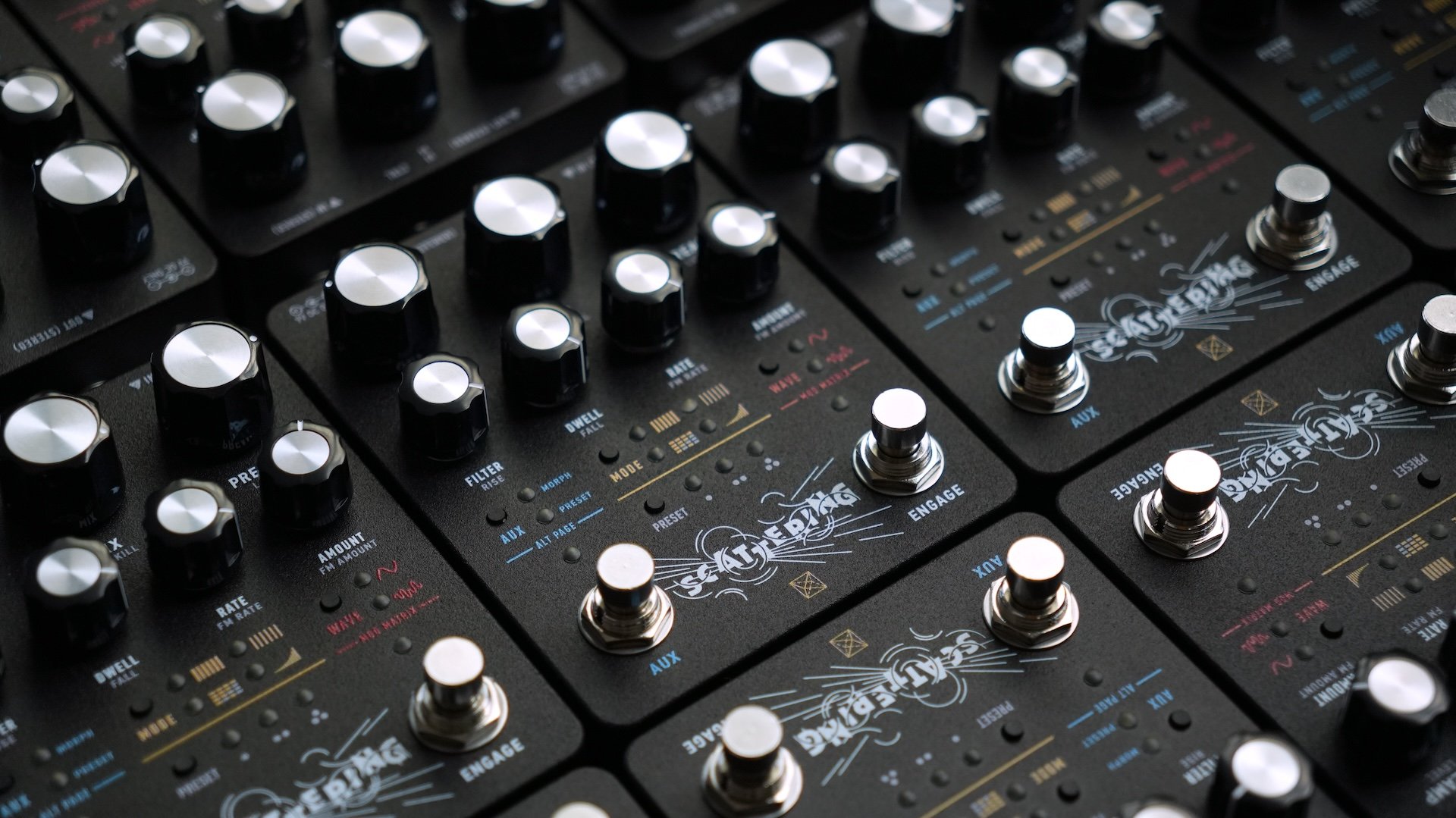
Today we are releasing a new reverb called Scattering. I have wanted to make this pedal for a long time.
Scattering is a stereo reverb built around tapped delay lines. Similar to our Prismatic Wall, it embraces a weird mixup of analog and digital processing. While nominally a reverb, it is equally capable of practical modulation-adjacent effects, ambient gazing, saturated double-tracking, or chaotic pitch-bendy noisemaking. Whether you’re a pragmatist or a space cadet, you will find something genuinely useful.
You probably want to hear the thing, so check out the videos below and head back here for more rambling.
In 2020 we released a pedal called Hypersleep. Then, in 2021, we pretty much immediately stopped making it. At the core of Hypersleep was a bucket brigade IC called the MN3011. Unlike more common BBDs with one output (like the MN3005 in Sending V2), the MN3011 has six staggered outputs. With careful mixing and feedback, it produces a uniquely fluttery, metallic reverb sound—like a slapback delay mixed with a tile room. By modulating the time, you could get some neat atypical chorus/vibrato effects too. And because I can’t help myself, we stuck a nice preamp in there. It’s a weird pedal but people fell in love with it.
The MN3011 was not long for this world. It arrived in the late 1970s, at the dawn of digital reverb. Commercially, it was doomed from the start, and chances of a reissue were nil. We scrounged up what we could, but the old stock supply dried up quickly and our source went dark. What little supply remains is priced absurdly high (trust me when I say we tried).
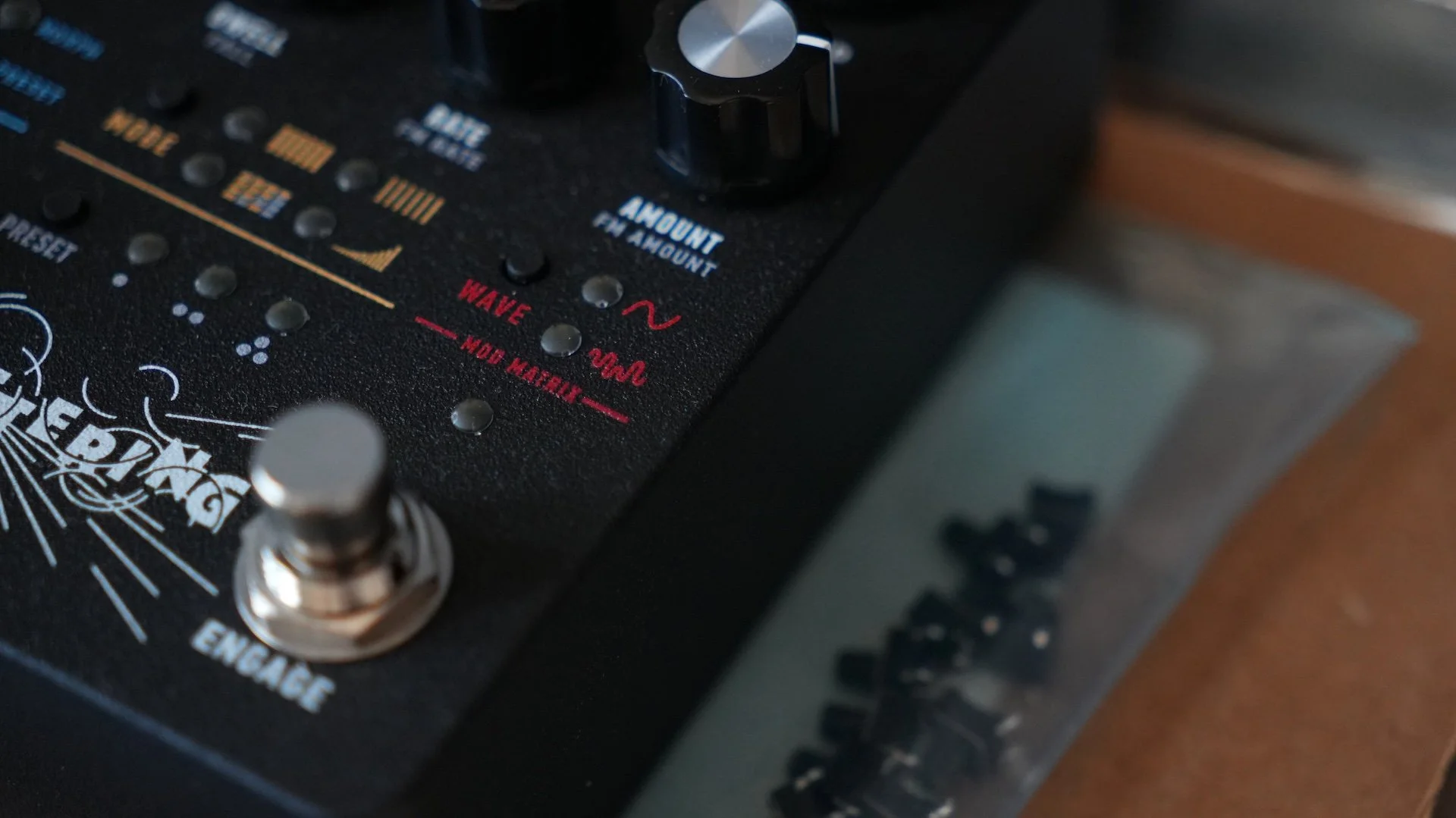
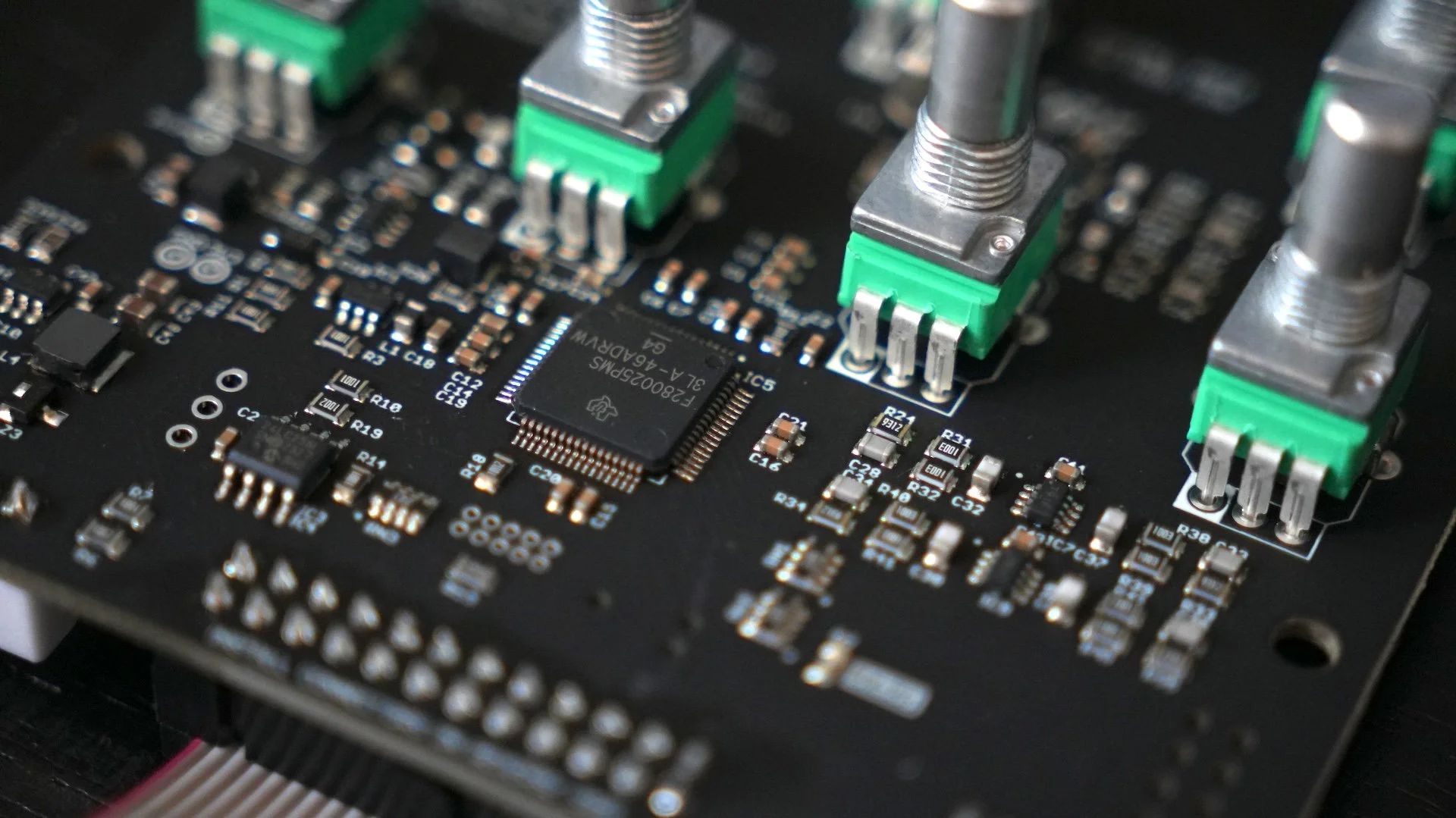
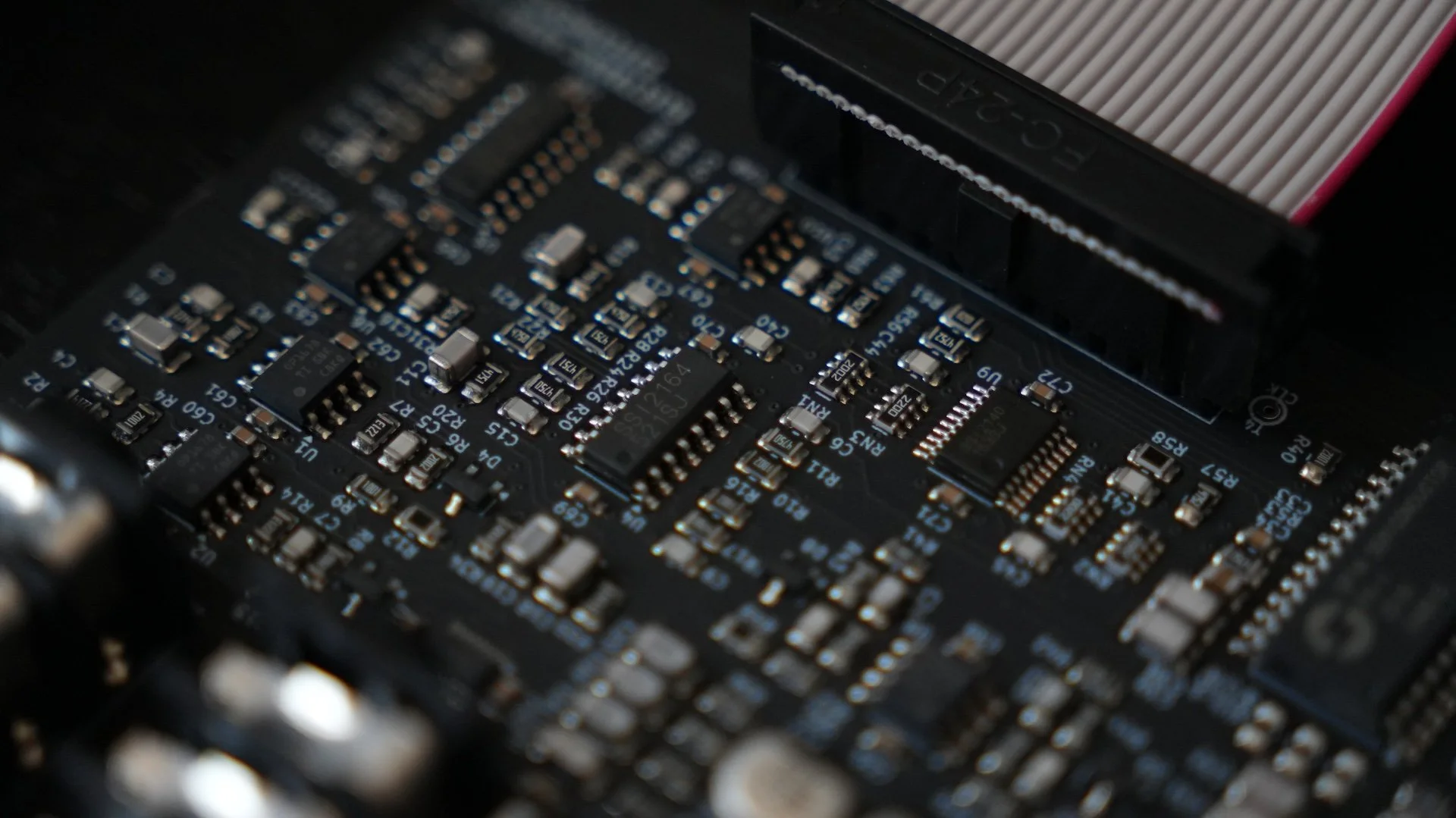
Before we go on, I should state plainly that Scattering is not Hypersleep. But, I think it is a worthy spiritual successor. If nothing else, hope it fills that void while going far beyond the capabilities of the original.
While working on Prismatic Wall I became much more comfortable with DSP. Replicating the tap ratios of the MN3011 is actually trivial, but it wasn’t enough. Instead, these ratios were simply the starting point. It was the right mix of continuity and limitations-as-creativity The four modes of Scattering all operate on two creative axioms. First, there is some magic to the delay tap ratios of the MN3011. Second, we avoided the use of all-pass diffusion—i.e., the primary technique used to “smear” digital reverbs.
This is a good a time as any to explain the name. Traditional reverbs are smooth and blurry, akin to the way light passes through mist or frosted glass. Tapped delay lines are like specular reflections, where light bounces off in clear paths. (I’m also reminded of particle collisions in general, which informed my pitch for Eric’s artwork. Eric totally crushed it.)
Metaphors aside, Scattering presents a distinct vision of reverb. It’s unusually lively and percussive, and it retains transient information in a way that sets it apart from other comparable pedals. I think, at its core, this is what originally made Hypersleep special too. And to enhance this, we expanded the analog capabilities to match. The preamp is now stereo, and the fixed filter found in Hypersleep is now movable. Of course you can adjust the timbre of the reverb, but you can also change the feel, or even dial in just the right amount of artifacts and noise.
On top of all this, Scattering is our first stereo effect. Learning to design in stereo was the biggest engineering challenge, and it proved to be a valuable learning experience. I have historically been an anti-stereo curmudgeon (I still kind of am at times). But I stand by my reasoning: guitar is a fundamentally mono instrument, and stereo mixing is impractical (if not outright detrimental) in the DIY shows that shaped my musical identity. Good stereo imaging in a mix often comes from multi-tracking, not effects. And no sane person wants to lug two tube amps to every gig. But also… a good stereo reverb is captivating. And being able to process synthesizers and program material is a big plus. And… if you do decide to lug around that pair of tube amps, it’s pretty darn nice.
I think I’ve said enough! I am so excited about this thing. All we can do now is put it out there and hope others are excited too.
Thanks everyone.
-John